

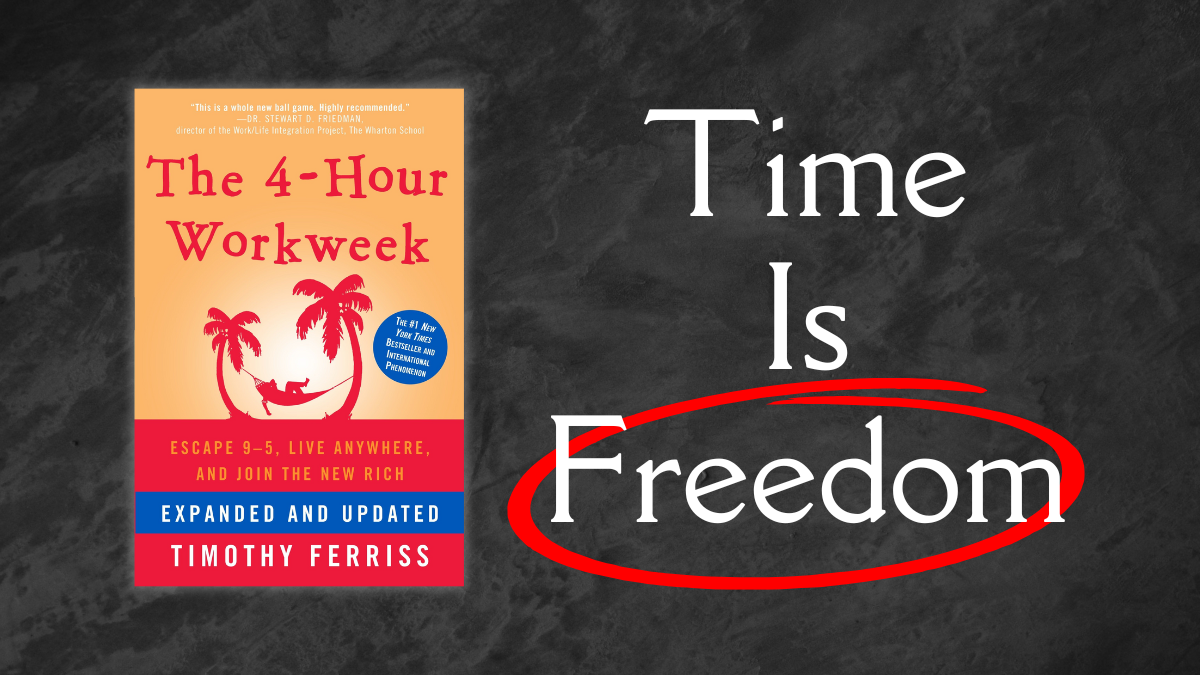
The 4-Hour Workweek: How Tim Ferriss Redefines Work and Life
The 4-Hour Workweek by Tim Ferriss challenges traditional work culture and offers a new way to design your life.
Latest posts



Do You Enjoyed This Article?
Join our community and get updated every week. We have a lot more just for you! Let’s join us now.
For many people, work is something to endure until the weekend or retirement. Long hours are often treated as a badge of honor, and productivity is measured by how busy you look. The 4-Hour Workweek challenges this mindset completely. Tim Ferriss argues that the goal of work should not be to stay busy. It should be to build a life with more freedom, flexibility, and meaning.
This book does not suggest that everyone should literally work four hours a week. Instead, it asks a deeper question. Why do we work the way we do, and who decided these rules in the first place?
“What we fear doing most is usually what we most need to do.”
Tim Ferriss
Ferriss invites readers to rethink assumptions about career, income, and time. The result is a provocative guide to designing life on your own terms.
The New Rich Versus the Deferred Life Plan
Early in the book, Ferriss introduces the concept of the New Rich. These are people who prioritize time and mobility over status and delayed rewards.
“People don’t want to be millionaires. They want to experience what they believe only millions can buy.”
Tim Ferriss
Ferriss contrasts this with the traditional deferred life plan, which encourages people to work long hours now so they can enjoy life later. He argues that this approach is risky and often unsatisfying. Life is unpredictable, and postponing happiness does not guarantee fulfillment.
The New Rich focus on lifestyle design. They aim to create freedom in the present rather than waiting decades to enjoy it.
The Myth of Time Management
One of the most important ideas in The 4-Hour Workweek is that time management is often the wrong goal. Ferriss believes that most people do not need better schedules. They need better priorities.
“Being busy is a form of laziness, lazy thinking and indiscriminate action.”
Tim Ferriss
Ferriss encourages focusing on effectiveness instead of efficiency. Doing more tasks faster does not matter if those tasks do not produce meaningful results. The book emphasizes identifying the few actions that create the most impact and eliminating the rest.
This idea challenges the culture of constant availability and endless to-do lists.
The Power of the 80/20 Principle
Ferriss relies heavily on the 80/20 principle, which states that a small percentage of efforts often produce the majority of results.
“Focus on being productive instead of busy.”
Tim Ferriss
He encourages readers to analyze where their time and income actually come from. Often, most results come from a small number of clients, tasks, or decisions. At the same time, most stress and distraction come from low-value activities.
By identifying and removing these distractions, people can dramatically reduce work hours without sacrificing results.
Selective Ignorance and Information Diets
Another provocative concept in the book is selective ignorance. Ferriss argues that constant news consumption and endless information often reduce clarity and focus.
“Develop the habit of non-finish.”
Tim Ferriss
Rather than trying to stay informed about everything, Ferriss suggests limiting input to what directly supports goals. This includes reducing email checks, avoiding unnecessary meetings, and cutting down on constant notifications.
By controlling information intake, mental energy is preserved for meaningful work.
Automation and Outsourcing
Ferriss introduces the idea of automation as a path to freedom. He explains how tasks that consume time can often be delegated or systemized.
“What you do is infinitely more important than how you do it.”
Tim Ferriss
This includes outsourcing administrative work, customer support, and repetitive tasks. Ferriss highlights the importance of building systems that run without constant involvement.
The goal is not laziness. It is leverage. By removing yourself from low-value work, you create space for creativity, learning, and life outside work.
Creating Income Without Being Tied Down
A key theme in The 4-Hour Workweek is separating income from time. Ferriss encourages building businesses or income streams that do not require constant presence.
“Relative income is more important than absolute income.”
Tim Ferriss
He explains that earning less money while living in a low-cost location and having freedom can be more satisfying than earning more while being trapped in an office.
This idea challenges traditional definitions of success and encourages readers to consider what they truly value.
Overcoming Fear and Comfort Zones
Fear plays a major role in keeping people stuck in jobs and routines they dislike. Ferriss addresses fear directly and offers practical exercises to confront it.
“What if I did the opposite for 48 hours?”
Tim Ferriss
He encourages defining worst-case scenarios instead of avoiding action. Often, the consequences of trying something new are far less severe than imagined.
This approach reduces anxiety and builds confidence. Taking small, calculated risks becomes easier when fear is clearly understood.
Mini-Retirements Instead of Retirement
Rather than saving all rest and enjoyment for old age, Ferriss proposes the idea of mini-retirements throughout life.
“Someday is a disease that will take your dreams to the grave with you.”
Tim Ferriss
Mini-retirements allow people to travel, learn, or pursue interests without waiting decades. These breaks can be taken at different stages of life and often cost less than expected.
This idea reframes retirement as a recurring experience rather than a distant event.
Why The 4-Hour Workweek Still Matters
Even years after its release, The 4-Hour Workweek continues to spark debate. Some ideas feel extreme, and not every strategy applies to every career. However, the core message remains powerful.
The book encourages questioning assumptions about work, success, and happiness. It reminds readers that many limits are self-imposed or socially inherited rather than necessary.
In a world where burnout is common, Ferriss’s emphasis on freedom and intentional living feels more relevant than ever.
Final Thoughts
The 4-Hour Workweek is not a blueprint to escape work entirely. It is an invitation to rethink how work fits into life.
“Life is too short to be small.”
Tim Ferriss
Tim Ferriss challenges readers to design a life that prioritizes time, mobility, and purpose. Whether or not you adopt every idea, the book offers a valuable shift in perspective. Instead of asking how to work harder, it asks how to live better.
True success, according to Ferriss, is not measured by hours worked or titles earned. It is measured by freedom, choice, and the ability to spend time on what truly matters.
Share to

Mustafiz Man
GoHighLevel & Paid Ads Expert