

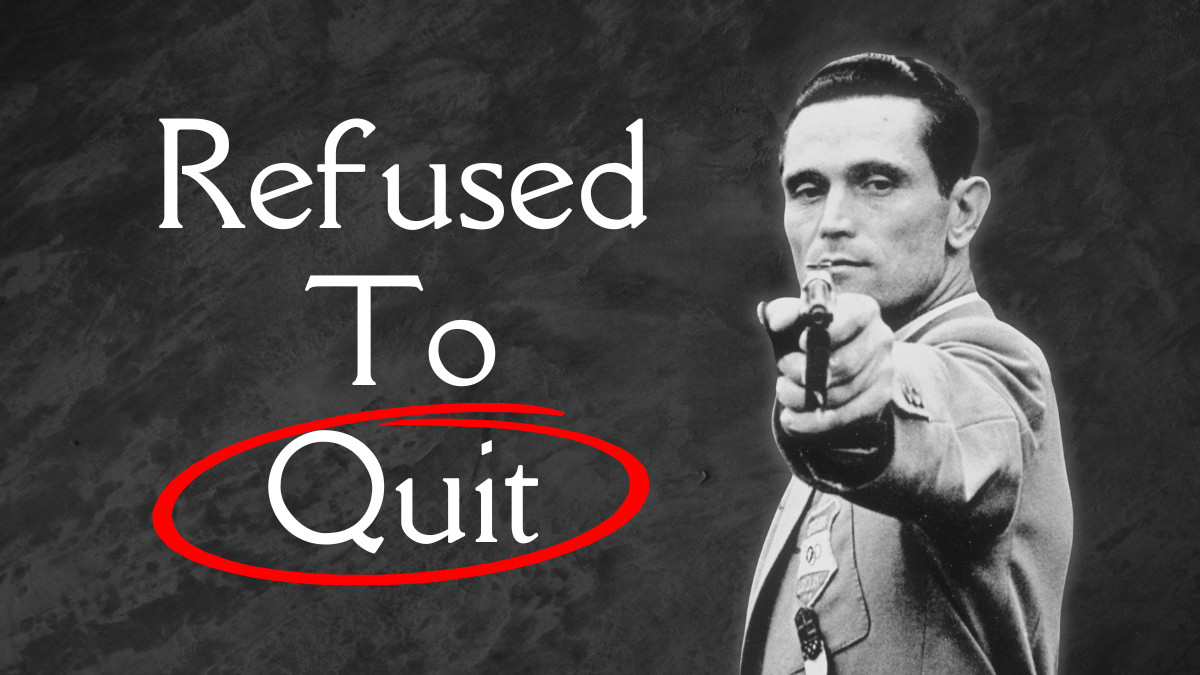
How Károly Takács Won Olympic Gold With One Hand
A powerful real-life story about resilience, quiet effort, and how Károly Takács refused to quit after losing his hand.
Latest posts



Do You Enjoyed This Article?
Join our community and get updated every week. We have a lot more just for you! Let’s join us now.
There are comeback stories, and then there’s Károly Takács.
You’ve probably never heard of him. He’s not on motivational posters, doesn’t have a massive social media following, and died decades ago in relative obscurity. But his story might be the most insane example of human resilience you’ll ever hear.
Picture this: You’re one of the best pistol shooters in the world. Your entire identity, your career, your Olympic dreams—all built around one skill. Then, in a single moment, a grenade explodes in your shooting hand and destroys it completely.
For most people, that’s game over. The end of the story. Time to find a new dream.
Károly Takács looked at his mangled right hand, then at his perfectly good left hand, and apparently thought, “Well, I guess I’ll just become the best left-handed shooter in the world instead.”
And that’s exactly what he did.
The Champion Before the Fall
Hungary in the 1930s was a powerhouse in competitive shooting, and Takács was their star. He was a sergeant in the Hungarian Army and a member of their world-champion pistol shooting team. In 1938, he was preparing for what should have been his crowning achievement—competing in the 1940 Olympics in Tokyo.
He was right-handed. This detail matters more than you might think.
During a military training exercise in 1938, a defective grenade exploded in Takács’s right hand. The damage was catastrophic. His shooting hand—the hand that held his dreams, his livelihood, his entire identity as an athlete—was completely destroyed.
Imagine being at the absolute peak of your abilities, on the verge of Olympic glory, and having it all ripped away in a fraction of a second. Most athletes would be devastated. Many would fall into depression. Some might never recover psychologically from that kind of loss.
Takács spent exactly one month feeling sorry for himself. Then he got to work.
The Secret Training
Here’s where the story gets almost unbelievable.
Takács didn’t announce his comeback. He didn’t do interviews about his journey or post training updates. He simply disappeared from the competitive shooting scene, and everyone assumed he was done. Finished. Another tragic story of potential cut short.
What they didn’t know was that Takács was training in secret.
Every single day, he practiced with his left hand. He had to completely retrain his muscle memory, his stance, his breathing, his trigger control—everything. It would be like a professional pianist losing their dominant hand and deciding to relearn every piece of music they’d ever mastered with the other one.
Keep in mind, this was 1938. There were no sports psychologists, no advanced prosthetics, no Instagram posts to keep him motivated. Just a man, a pistol, and a decision that most people would call insane.
He trained in silence for a year. Then World War II broke out, and the 1940 Olympics were cancelled. So were the 1944 Games. Takács kept training. For an entire decade, he practiced with his left hand, never knowing if he’d ever get the chance to compete again.
Think about that level of dedication. Ten years of training for an opportunity that might never come.
The Comeback Nobody Saw Coming
When the Olympics finally resumed in 1948 in London—the first Games after the war—Károly Takács showed up to compete. He was 38 years old, shooting left-handed, and nobody expected anything from him.
His fellow competitors were surprised to see him at all. Some didn’t even recognize him. Others offered their condolences about his injury, probably assuming he was there in some coaching or administrative capacity.
Then the competition started.
One of his rivals, world-class shooter Carlos Enrique Díaz Sáenz Valiente from Argentina, supposedly approached Takács before the event and showed off his new pistol, confident about his chances. He asked Takács about his own preparation.
Takács’s response? He’d show him his new technique in the competition.
And show him he did.
Takács won the gold medal in the 25-meter rapid fire pistol event, beating the same competitors who had pitied him just days earlier. He didn’t just win—he won convincingly, proving that his decade of secret training had transformed him from a championship-level right-handed shooter into a championship-level left-handed shooter.
The shooting world was stunned. The man they’d written off had just won Olympic gold with his “wrong” hand.
But Wait, It Gets Better
Winning a single Olympic gold medal after losing your shooting hand would be enough for any movie script. It would be the perfect ending to an inspirational story.
Takács wasn’t interested in perfect endings. He was interested in proving that his first gold medal wasn’t a fluke.
Four years later, at the 1952 Helsinki Olympics, Takács returned to defend his title. He was now 42 years old—ancient by competitive shooting standards—and facing a new generation of younger competitors with two perfectly functional hands.
He won gold again. Not only that, but he set a world record in the process.
Let that sink in. A man who lost his shooting hand won back-to-back Olympic gold medals and set a world record using his non-dominant hand. It’s the kind of achievement that sounds too perfect to be true, but it absolutely happened.
The Philosophy Behind the Performance
Takács rarely gave interviews or made grand philosophical statements about his achievement. He was a quiet, humble man who simply did the work. But when asked about his remarkable comeback, he did share some insights that reveal his mindset.
He reportedly said that his right hand had become “good only for shooting a handshake,” but he had another hand that was perfectly capable of learning.
That simple reframe is everything. He didn’t focus on what he’d lost. He focused on what he still had. He didn’t waste energy on anger or self-pity. He channeled it into action.
There’s no evidence he ever complained about the unfairness of his situation. No interviews where he discussed the emotional trauma of losing his dreams. No tell-all book about overcoming adversity. He just quietly became excellent at something everyone assumed was impossible.
Why This Story Hits Different
In our current era of instant gratification and viral overnight success stories, Takács’s decade of silent, unglamorous training feels almost alien. He didn’t crowdfund his comeback. He didn’t build a personal brand around his adversity. He didn’t even tell anyone what he was doing.
He just worked. For ten years. With no guarantee of success.
That’s the part that makes this story so powerful and, frankly, so challenging. Takács didn’t have the luxury of knowing his story would have a happy ending. He trained through a world war, through personal tragedy, through countless moments when quitting would have been completely understandable.
But he didn’t quit. He didn’t make excuses. He didn’t wait for conditions to be perfect or for someone to believe in him. He believed in himself, and he did the work.
The Lessons in the Left Hand
Takács’s story offers some uncomfortable truths. First, that the obstacles we face—while very real and often devastating—don’t have to be the end of our story. We get to decide what comes next.
Second, that real transformation happens in private, in the unsexy daily grind that nobody sees or celebrates. Takács’s gold medals were won in those thousands of hours of secret training, not in the brief moments on the Olympic podium.
Third, that our limitations are often more flexible than we think. Takács didn’t just overcome his disability—he became better with his left hand than most people ever become with their dominant hand. He didn’t lower his standards; he met them with a different approach.
The End of the Story
After his second Olympic victory, Takács continued to compete and coach, eventually becoming a shooting instructor. He never became wealthy or famous outside of Hungary and shooting circles. He died in 1976, having lived a relatively quiet life after his remarkable Olympic achievements.
But his legacy endures in a simple, powerful idea: your circumstances don’t determine your potential. Your response to those circumstances does.
You probably won’t face the exact challenge Takács did. But you’ll face something. A setback, a loss, a moment when it feels like the dream is dead and there’s no path forward.
When that moment comes, remember the Hungarian shooter who lost his right hand and became a two-time Olympic champion with his left. Remember that he didn’t do it by complaining, by waiting for perfect conditions, or by lowering his standards.
He did it by making a decision and then backing it up with a decade of work that nobody saw, nobody celebrated, and nobody believed was possible.
Until the moment he proved them all wrong.
That’s the Károly Takács story. Not just a story of overcoming adversity, but a masterclass in quiet determination, unwavering focus, and the refusal to let circumstances write your ending.
Your move is your move. Your hand is your hand. What you do with it is entirely up to you.
Share to

Mustafiz Man
GoHighLevel & Paid Ads Expert